What Should a 1-Year-Old Be Playing With? The Honest Parent's Guide

Your baby just turned one. The internet has opinions. Relatives have opinions. The toy aisle definitely has opinions, most of them loud, plastic, and battery-powered.
Here's the honest answer: a 1-year-old doesn't need much. But what they do need matters enormously.
This is what's actually happening in that little brain at 12 to 18 months, and the toys that match it.
What Is a 1-Year-Old Developmentally Ready For?
At 12 months, children are pulling to stand, beginning to walk, and developing whole-body coordination at speed. They're pointing, babbling, and building the foundations of language even before words arrive. They're dropping, posting, and inserting objects with real intent, not mischief. Cause and effect is everything right now. And they're watching you constantly, absorbing everything you do and desperate to copy it.
The single biggest mistake parents make? Buying for the age their child will be, not the age they are. A toy that's too complex doesn't challenge a child. It frustrates them.
The Best Toys for 1-Year-Olds
Shape Sorters and Posting Toys
Posting shapes, dropping objects through holes, pressing things that pop back up - this is the 1-year-old's obsession, and for good reason. It's how they learn that actions have consequences, that shapes have properties, and that persistence pays off.
Our Pull Along Shape Sorter is independently safety tested and designed from 12 months, with chunky pieces sized for small hands and the added pull-along element that supports early walking confidence at the same time.

Stacking and Nesting Toys
The joy is in the building and the knocking down. That's not destruction - that's gravity, balance, and early spatial awareness in action. A child will stack and topple the same tower fifty times. Let them.
Our Rainbow Stacking Rings are suitable from 12 months and colour-coded to introduce early colour recognition without overwhelming. The Early Years Stacker is another brilliant option from 12 months for children just getting to grips with the concept.
Sensory Toys
At this age, every texture, sound, and weight is new information. Toys that engage multiple senses simultaneously are doing serious developmental work.
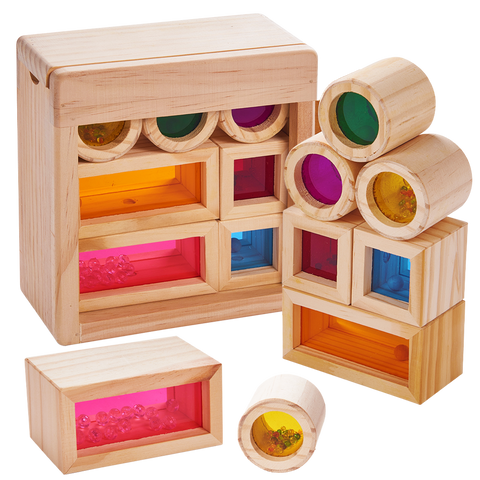
Our Sensory Sounds Blocks are designed from 10 months and combine visual colour, tactile texture, and gentle sound into one toy, giving a 1-year-old's brain plenty to process without any batteries required.
Simple Wooden Puzzles
Two or three large pieces with chunky wooden knobs. That's all. The goal isn't puzzle completion, it's hand-eye coordination, shape recognition, and the deeply satisfying moment when the piece drops into place. The knob grip also directly strengthens the pincer grasp needed for writing, years later.
Our Animal Puzzles are designed from 12 months with large, easy-grip pieces and bright illustrations that hold attention.
Pull-Along Toys
Walking confidence builds fastest when children have something to engage with on the move. A pull-along toy turns a wobbly walk into a mission.
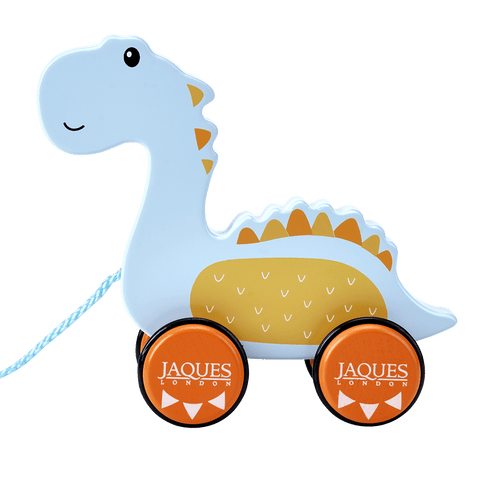
Our Dylan the Dinosaur Pull Along is designed from 12 months, with a smooth rolling action and just the right amount of noise to keep a new walker motivated.
Cause and Effect Toys
Pop-up toys are endlessly fascinating at this age because they make something happen. Press this, that appears. That's a genuinely exciting discovery when you're 12 months old.
Our Pop Up Penguins are designed from 12 months and give children the satisfying experience of controlling an outcome themselves, which is one of the most important things a 1-year-old can learn.
What to Avoid at Age 1
Toys with too many functions. If pressing one button produces five different things, a 1-year-old can't form a clear cause-and-effect understanding. Simpler is always smarter at this stage.
Screen-based "educational" apps. Passive screen interaction doesn't replicate the three-dimensional, tactile learning that physical toys provide. The best learning toys for 1-year-olds have weight, texture, and resistance.
Anything with parts under 3cm. UK toy safety standards (UKCA and CE) flag this as a choking hazard for under-3s. Always check before buying.
Why Wooden Toys Work Best at Age 1
Wood has natural heft that plastic lacks. It gives children real sensory feedback about what they're holding. It's durable enough to survive the drop-and-gnaw cycle of early toddlerhood. And it contains no BPA, no microplastics, and no parts that snap off unexpectedly.
All Jaques of London wooden toys are independently tested to UKCA and CE toy safety standards, with non-toxic water-based paint throughout.

Frequently Asked Questions
What toys are best for a 1-year-old's development? Shape sorters, stacking toys, simple wooden puzzles, pull-along toys, and sensory toys are consistently recommended by early years specialists. They build fine motor skills, spatial reasoning, cause-and-effect understanding, and early language development simultaneously.
How many toys should a 1-year-old have? Fewer than you think. Research on toy rotation consistently shows that children play more creatively and for longer with fewer toys available at once. Six to eight toys at any time is plenty. Rotate every two to three weeks to keep things feeling fresh.
Are wooden toys safe for 1-year-olds? Yes, provided they meet safety standards. Look for UKCA and CE marking, non-toxic water-based paint, no parts under 3cm, and smooth sanded edges. All Jaques of London toys meet these standards.
Should a 1-year-old have Montessori toys? Montessori principles align well with 1-year-old development. Open-ended, hands-on toys that let children discover outcomes themselves, without flashing lights or electronic prompts, match how children this age actually learn. Most of our range for 1-year-olds fits naturally within a Montessori approach.
Jaques of London, making toys that match how children actually develop, since 1795.