How to Raise an Independent Toddler - The Play Way

You can't teach independence by telling a toddler to be independent. But you can design for it. Every parent wants it. A child who can play alone without the running commentary of "I'm bored." A child who tries before they ask. Who attempts the zip. Who has a go with the puzzle before deciding it's impossible.
And here's the thing most parenting advice gets wrong: independence in toddlers isn't a personality trait. It's a skill. And like every other skill, it has to be practised.
The fastest way to practise it? Play.
Why Independent Play Is a Developmental Skill, Not a Personality Type
Children who play independently aren't born that way. They become that way because their environment has consistently given them three things: toys they can actually succeed with on their own, space to experience mild challenge without immediate rescue, and enough confidence in their own competence to try.
That third one is the crux of it. Confidence isn't something you talk a toddler into. It's something they earn through repeated small victories. Every time a 12-month-old fits a shape through the right hole without help, every time a 2-year-old figures out the puzzle, every time a 3-year-old threads the bead, they're logging evidence that they can do hard things.
Those tiny deposits build into a child who approaches challenges with curiosity instead of panic.
The Toys That Build Independent Play
Self-Correcting Toys
The single most powerful category for independent play is toys that give children their own feedback without needing a parent to say "well done" or "try again." If the piece doesn't fit, the child knows immediately. If the tower topples, the cause is obvious. The toy itself does the teaching.
Our Pull Along Shape Sorter from 12 months is a brilliant example. The child doesn't need validation, either the shape goes in or it doesn't. That's the feedback loop, and it works without a parent in the room.
Our Rainbow Shape Puzzles from 12 months follow the same principle. The pieces are self-correcting, they only fit one way, and the child learns to trust the process rather than looking for adult approval.

Open-Ended Toys That Don't Run Out
The toys that sustain independent play longest are the ones with no definitive ending. A child can't "finish" a set of building blocks. They can't exhaust all the possibilities of a wooden farm or a vehicle play set. Open-ended toys invite children to generate their own scenarios, which is precisely the kind of thinking independent play depends on.
Our Kids Building Blocks suit children from 12 months to age 5 and represent probably the best investment in independent play available in toy form. There is always something new to build.
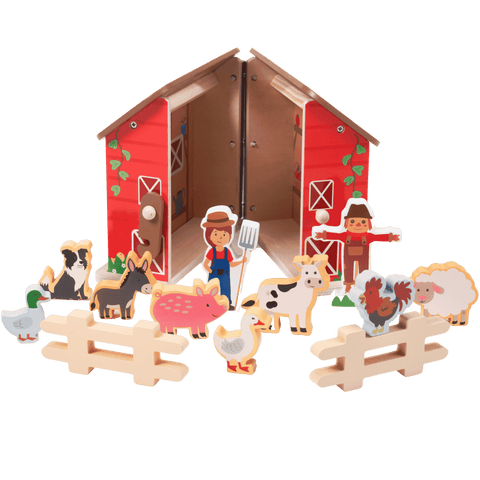
Our Friendly Farm from 12 months sustains imaginative independent play well into the preschool years. At 12 months, a child sorts the animals. At 2, they load and unload. At 3 and 4, they're running an elaborate farm operation with stories, rules, and characters.
Graduated Challenge Toys
Toys that grow harder as children grow more capable keep children in what educators call the zone of proximal development, just challenging enough to require effort, not so hard as to cause shutdown. These are the toys children return to again and again because there's always a next level.
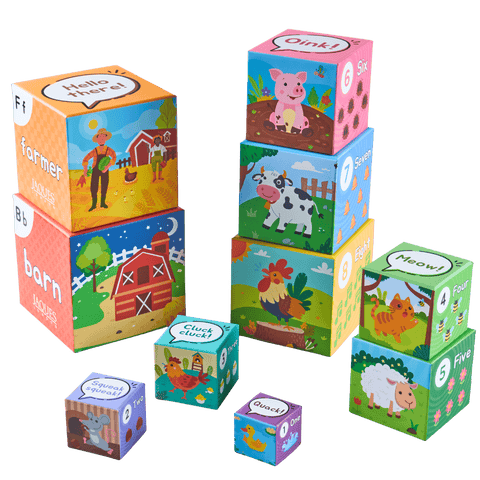
Our Stack 'N' Learn Cubes from 12 months work beautifully this way. Stacking at 12 months, colour matching at 18 months, number recognition at 2 and 3, counting and sequencing from 4. One toy, years of independent engagement.
Our Counting Dinosaur from 12 months follows the same arc, evolving from a simple number recognition toy to a genuine counting and sequencing challenge as children get older.
Toys That Imitate Real Life
Toddlers between 2 and 3 are intensely motivated by adult life. They want to do what you do. And role play toys that reflect real-world activities are the ones that generate the longest, most focused independent play sessions.
Why? Because children have a clear mental model to follow. They've seen how a kitchen works, how a car is driven, how things are built. They don't need instructions, they already have a script. They just need the props.
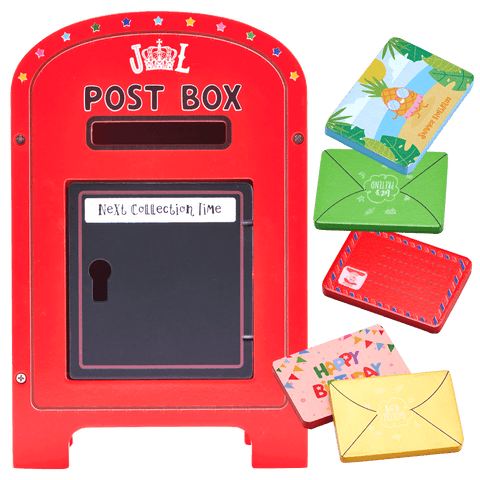
Our Wooden Post Box from age 2 is a great example of a real-world activity that translates into sustained independent play. Posting, sorting, retrieving, starting again.
Our Wooden Aeroplane from age 2 and Wooden Campervan from age 2 give children familiar real-world vehicles to drive, load, and narrate their own stories around.
Creating the Right Environment
The toys matter. But so does the environment around them.
Rotate, don't accumulate. Fewer toys available at once means children engage more deeply with each one. Swap every two to three weeks and watch the engagement reset.
Stay nearby but don't intervene immediately. The urge to help the moment a child looks frustrated is natural, but waiting ten seconds before stepping in gives children the chance to solve it themselves. That gap is where independence lives.
Let them finish. Interrupting play, even for something nice, disrupts the focus that independent play requires. If a child is absorbed, the washing up can wait.

Frequently Asked Questions
How do I get my toddler to play independently? Start with toys they can succeed with on their own. Self-correcting toys that don't require adult validation are the best starting point. Gradually increase the challenge as confidence builds. The goal is a child who trusts their own instincts and capabilities, and that comes from repeated small wins.
Why won't my 2-year-old play alone? Often it's about the toys rather than the child. Toys that require adult input, either because they're too hard, too easy, or because they have no natural next step, don't sustain independent play. Try open-ended wooden toys with no single "correct" outcome and see if that changes things.
At what age can toddlers play independently? Brief independent play is possible from around 12 months. By 2, most children can sustain it for 10 to 15 minutes with the right toys. By 3, 20 to 30 minutes is realistic. These are skills that develop gradually, a child who struggles at 18 months will often surprise you at 2.
Are wooden toys better for independent play than plastic? Generally, yes. Wooden toys tend to be simpler, more open-ended, and don't run on batteries that die mid-session. They also don't provide constant electronic feedback, which means children have to generate their own. That's the exact skill independent play is trying to build.
Jaques of London, designing for independence, one toy at a time, since 1795.